
I've recently found myself doing something I haven't done in quite a while.
I'm running chemistry experiments again!
There aren't any flasks on my desk. No solvents, no fume hood, and no reaction mixtures bubbling away. In fact, the closest thing to laboratory equipment is a rather powerful NVIDIA graphics card sitting inside my desktop computer.
But the experiments are running, the molecular structures are moving, and I'm once again finding myself genuinely excited to see what the results look like.
It's a familiar feeling, and one I didn't realize how much I'd missed.
A Little History
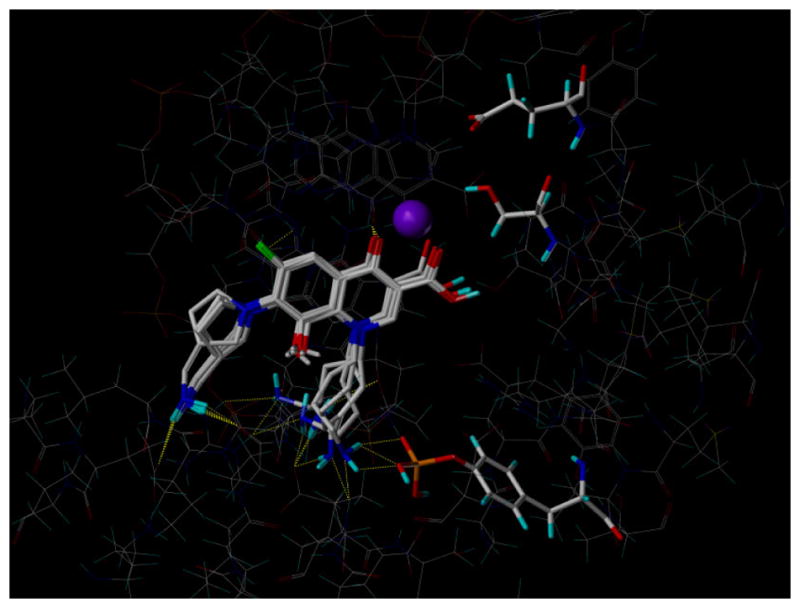
My background is in medicinal chemistry. During my graduate research, I worked on designing and synthesizing novel fluoroquinolone derivatives, investigating how changes to molecular structures might influence their biological activity.
That work included computational chemistry, too.
Back around 2009–2012, I was using SYBYL for molecular modeling and structure-based investigations. I remember how sophisticated that software seemed at the time, and how expensive access to serious computational chemistry tools could be.
Molecular modeling wasn't exactly something you casually set up on a home computer.
Much of the work depended on specialized software, institutional resources, and access to computational infrastructure.
And, of course, there was the traditional chemistry: synthesizing molecules, characterizing compounds, interpreting results, and figuring out why something did or didn't behave the way you expected.
That's the part of science I've always loved.
You start with a question, design an experiment, run it, and see what happens. Sometimes the results are encouraging. Sometimes you're left scratching your head and wondering what on earth happened.
Either way, you've learned something, and usually you've come up with another experiment you'd like to try.
Fast-Forward to 2026
A lot has changed.
Today, I'm running molecular docking calculations and molecular dynamics simulations on my own workstation, using scientific software that's available without the enormous proprietary licensing costs I remember from graduate school.
And the hardware is astonishing.
My RTX 5080, a graphics card designed primarily for gaming and high-performance computing, can perform the calculations needed to simulate molecular systems over time.
I'm currently using it to investigate interactions between statin-derived molecules and HMG-CoA reductase, the enzyme targeted by statin medications.
The work involves molecular design, computational preparation, docking, molecular dynamics, and analysis of the resulting trajectories.
Some of these simulations follow the movements of thousands of atoms across millions of computational steps.
And when the calculations finish, I get to investigate what happened.
Did the molecule maintain its position? Did its interactions change? How did the protein respond? How does one candidate compare with another, or with a reference compound?
Those are interesting chemical questions, and answering them requires the same combination of chemical intuition, careful experimental design, skepticism, and interpretation that drew me to medicinal chemistry in the first place.
A Different Kind of Laboratory
Truthfully, there's nothing quite like using your hands to set up a reaction in the hood for an overnight experiment. The tactile part of organic synthesis and analytical chemistry can never be fully replaced for me.
Even still, running overnight molecular dynamics experiments is exhilarating after such a long break! And don't even get me started on how much I love analyzing the data and creating visualizations!
There's something particularly satisfying about getting up in the morning and checking on an experiment that's been running all night. I remember doing that in the chemistry lab, although now I'm checking simulation logs instead of looking at reaction mixtures.
The computer has been working through an enormous number of calculations, generating a trajectory of molecular behavior under carefully defined conditions.
Once the simulation is finished, I can analyze that trajectory, quantify structural changes, compare independent simulations, and visualize what happened.
I can even produce animations of molecules moving and interacting!
It's a pretty remarkable capability to have sitting in my office.
Of course, computational experiments aren't the same as physical laboratory experiments. We're investigating molecular behavior through mathematical models, and those models have assumptions and limitations that need to be understood. A promising docking result or a stable molecular dynamics trajectory doesn't automatically translate into biological activity.
But the computational work can tell us a great deal, especially when the experiments are carefully designed and the results are interpreted appropriately.
What particularly interests me is the ability to work iteratively. I can design a molecular structure, investigate its possible binding geometry, run a simulation, examine the results, and use what I've learned to plan the next experiment.
It's an enjoyable way to spend my time, and I've found myself thinking about chemistry even when I'm not sitting at the computer.
Why I'm Doing This Now
I've started a new initiative called Towle Therapeutics, focused on independent computational chemistry research and scientific consulting.
The current statin project is my initial demonstration of the research capabilities I'm developing.
I don't have a particular attachment to statins. They're an interesting and scientifically useful starting point for demonstrating an integrated computational medicinal chemistry workflow. Once that work is complete, there are plenty of other molecular systems and research questions I'd like to investigate.
What interests me most is having the tools and independence to pursue those questions.
I want to design computational experiments, examine molecular behavior, generate reproducible results, and contribute useful findings to medicinal chemistry research. I also hope to publish the work and make the methods and results available for other scientists to evaluate and build upon.
I'm interested in using these capabilities to help other researchers, too. There are plenty of interesting chemical questions out there, and not everyone has convenient access to the computational resources or specialized workflows needed to investigate them.
That's part of what I'm building Towle Therapeutics to do.
It's Good to Be Back
What surprises me most about all of this is how quickly the old excitement returned.
There's a particular kind of anticipation that comes with running an experiment. You know what you're testing, and you probably have a pretty good idea of what you expect to happen. But until you examine the results, you don't really know.
I remember that feeling from my earlier chemistry research.
And now, years later, here I am again, checking experiment progress, looking at molecular structures, thinking about experimental controls, and planning the next investigation.
Only this time, instead of walking into a chemistry laboratory, I walk into my office.
I still have plenty to learn and plenty of work ahead of me. That's part of the fun.
It's good to be doing chemistry again!
Interested in What I'm Working On?
Visit Towle Therapeutics to learn more about my computational chemistry research, molecular modeling, molecular dynamics simulations, and opportunities for scientific collaboration.