
I did not set out to solve an HVAC problem.
I set out to build an autonomous crypto researcher.
Somehow I ended up doing both.
For the last several months, I’ve been building Crypto Strategy Lab, or CSL. The goal is not to have an AI spit out “buy this coin” recommendations. I wanted something closer to an actual research system.
It proposes testable hypotheses, compiles them into deterministic experiments, runs those experiments against governed historical data, records what happened, remembers what it has already investigated, and uses that accumulated research to decide what to investigate next.
Getting it to do research was one problem.
Getting it to do research in a way that didn’t take over my computer and my life was another.
For a while, running autonomous research meant committing my GPU for hours and hours at a time. That works, technically, but I also use this computer for everything else I build. I don’t particularly want to burn the GPU continuously for days just because the software can keep going.
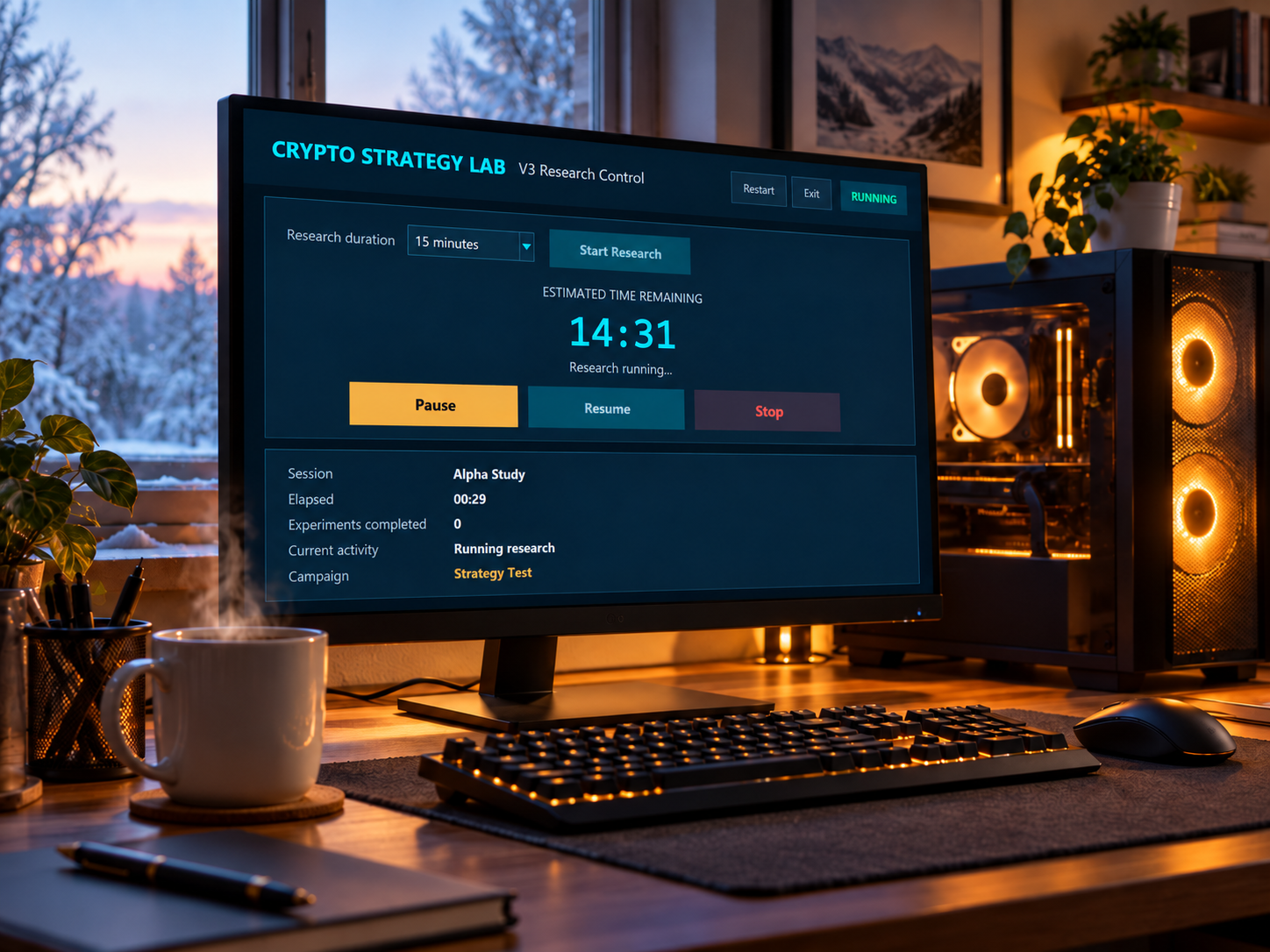
So I finally built a little desktop control interface for it.
Now I can tell CSL:
Research for 15 minutes.
Or 30 minutes.
Or an hour.
Or two hours.
Or four.
Or just keep going until I tell you to stop.
I can pause it after the current scientific action, resume later without losing the campaign’s memory, or tell it to stop cleanly. The whole idea is that research can accumulate around my schedule instead of my schedule having to revolve around the research.
And this morning I discovered a ridiculous secondary benefit.
My office is cold in the morning.
Normally I might turn on the electric wall heater for a while.
But I also have a fairly serious GPU sitting a few feet away.
And GPUs are exceptionally good at turning electricity into heat.
So this morning, instead of turning on the heater, I gave Crypto Strategy Lab one hour of research.
Then I walked the dog, got some coffee, and went about my morning.
When I came back, the cold edge was off the office.
Also, my computer had completed 63 crypto research experiments.
It ran for a little over an hour because it finished the scientific action it was working on instead of chopping it off at exactly 3,600 seconds. All 63 experiments completed, none were rejected, trading remained disabled, and the protected final holdout remained untouched.
So apparently I have built the world’s most overengineered space heater.
It just happens to do research while it heats the room.
And no, I have not discovered free energy. If I’m comparing it with a normal electric resistance heater, both devices are ultimately turning electricity into heat.
The difference is that one of them also spends the morning testing hypotheses.
This particular hour actually moved the research campaign quite a bit.
At the start of the session, CSL had covered 474 of 1,026 coarse research scopes. By the end it had covered 537, meaning this one run pushed the campaign past the halfway point. It now has 558 completed experiments across 541 research lineages. Almost all of those lineages are still exploratory, which is exactly where they should be at this stage.
I think one specific experiment from this morning shows what I mean when I call this “research.”
CSL noticed that it had not yet examined one particular relative-value relationship between Bitcoin Cash and Chainlink on daily data.
So it proposed a hypothesis that the BCH/LINK price relationship might show mean-reverting behavior.
Then it turned that into an actual experiment.
It calculated the logarithmic price spread between BCH and LINK and compared that spread with its previous 20-day median. When the spread moved at least 0.01 log units below that baseline, the experiment asked whether it moved back toward the baseline one day later.
There were 131 usable historical events.
In 52.7% of them, the spread moved in the hypothesized direction.
The median effect was slightly positive.
The average effect was actually slightly negative.
So based on the information from that experiment, the directional result is basically a coin toss.
Not exactly time to call the Lamborghini dealer.
And I love that result.
Not because it found something useful, but because it didn’t need to.
The system came up with a question, checked whether it had already researched that question, converted it into an executable test, used the governed historical data available to it, ran the experiment, got a thoroughly unimpressive answer, recorded that answer, and moved on.
That is a lot more interesting to me than building an AI that enthusiastically discovers a “promising strategy” every ten minutes.
Sometimes research should say:
“Eh. Probably nothing here.”
This morning’s full hour was similar.
Some experiments produced observable effects. A lot of them produced insufficient evidence. The campaign now has hundreds of active exploratory research lineages and only one that has reached its replicated-or-robust evidence state. None have been approved for the protected final holdout.
There’s a lot more work to do.
But something changed when I added that little Start button.
I used to think autonomy meant:
“The computer can work for a long time without me.”
Now I think useful autonomy is closer to:
“The computer can work around my life.”
It can use the hour I have available.
It can stop safely.
It can remember what it learned.
Tomorrow it can continue where it left off.
Thirty minutes here. An hour there. Maybe four hours when I don’t need the GPU for anything else.
The research accumulates.
I don’t have to babysit it.
And apparently I can schedule some of that compute for cold mornings and get a little bonus heating out of the deal.
So no, I still haven’t found a winning crypto investment strategy.
But at least I can keep my hands warm along the way.